
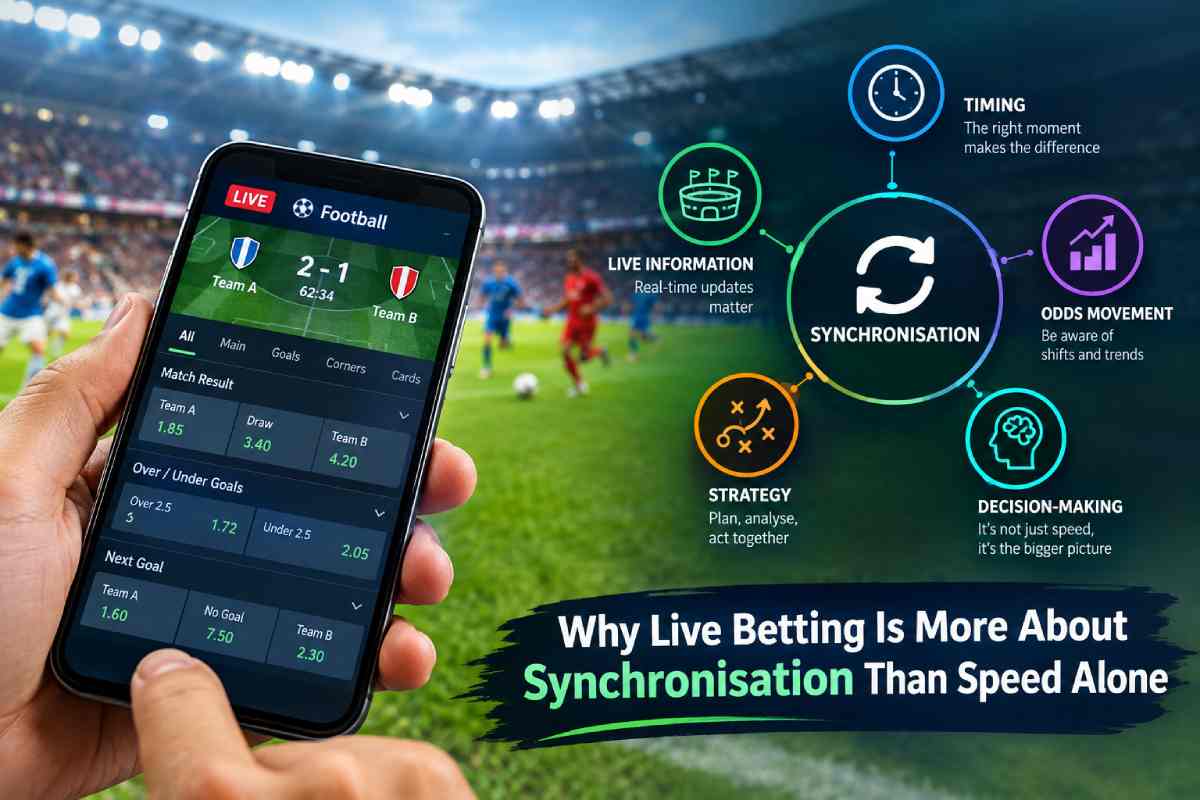
Speed gets most of the attention in live sports betting, but it is only part of the job. A platform can refresh quickly and still feel wrong if the score, clock, markets and match events are not all moving together. That is where synchronisation matters. For anyone placing a sport bet while the match is already underway, seeing the right information at the right moment is often more important than simply seeing it fast.
Take a goal as the obvious example. The scoreboard changes, a market may close for a moment, odds are recalculated and the whole page has to catch up without different sections showing different versions of the same match. On Betway, the sport betting side of that process depends on those updates landing in the right order, because placing a sport bet only makes sense when the score, clock and market are all reflecting the same moment. Sports betting works best when the data feels joined up, not when it arrives in pieces.
That is also why live betting cannot be treated as a simple race to publish the latest number first. Each update has to make sense alongside everything else already on the screen. A fast refresh is useful, but only if the match data, market status and user action are still telling the same story.
Fast data is useless if it is out of step
A live platform may receive information from several places at once. Scores, cards, substitutions and market changes do not always come from one single feed, which means the system has to know what happened first and what should change next.
This is where the tech becomes more important than the user ever sees. Sports betting platforms have to process updates, check them and make sure the visible market still matches the match itself. Placing a sport bet during live play depends on that chain staying in order.
A sport bet based on stale information is not made in the same situation as one based on the current match, even if only a few seconds separate the two.
The clock creates its own problems
Football is constantly moving, even when nothing dramatic happens. A 0-0 after twenty minutes and a 0-0 after eighty minutes are completely different situations.
Sports betting has to reflect that. Time left on the clock changes how markets are priced, so the platform cannot simply wait for goals or cards before updating. Anyone placing a sport bet late in the match is dealing with a much smaller window than someone placing a sport bet early on.
That sounds simple, but it means the clock, score and markets all need to remain aligned from kick-off to full time.
Mobile connections make synchronisation harder
Live sports betting does not always happen on perfect Wi-Fi. A user may be on mobile data, moving between networks or dealing with a brief drop in signal.
The platform still has to recover cleanly. If a sport bet has been submitted, the user needs to know what happened rather than wonder whether the request disappeared somewhere in between. Good tech is not only about speed here; it is about making sure the app returns to the correct state once the connection comes back.
Later in the match, when Betway or another sports betting service refreshes live markets, the important part is that every visible piece of information matches the same moment of the game.
Synchronisation is what makes speed useful
Live sports betting will always depend on fast updates, but speed on its own does not solve much. A platform can be quick and still be wrong, confusing or out of sequence.
That is why placing a sport bet during live play is really a synchronisation problem. The score, match clock, events and market all have to tell the same story.
For the user, it should feel simple. Check the match, look at a sport bet and decide whether placing a sport bet makes sense. Everything complicated should stay underneath the surface.
That is the point. In sports betting, speed gets noticed, but synchronisation is what makes the whole thing actually work.